Commercial HVAC rooftop drone thermal inspection: A practical guide to safer, faster building assessments
Key Takeaways
A commercial HVAC rooftop drone thermal inspection can give facility teams useful evidence before anyone climbs onto a roof. The best results come from careful planning, consistent image capture, and disciplined interpretation.
- Thermal imagery can reveal unusual heat patterns that deserve closer investigation.
- Drones reduce unnecessary rooftop exposure while improving visual coverage.
- Thermal findings are indicators, not a replacement for hands-on testing.
- Clear documentation helps maintenance teams rank repairs by urgency.
- Provider qualifications, reporting quality, safety practices, and data handling all matter.
What commercial HVAC rooftop drone thermal inspection reveals
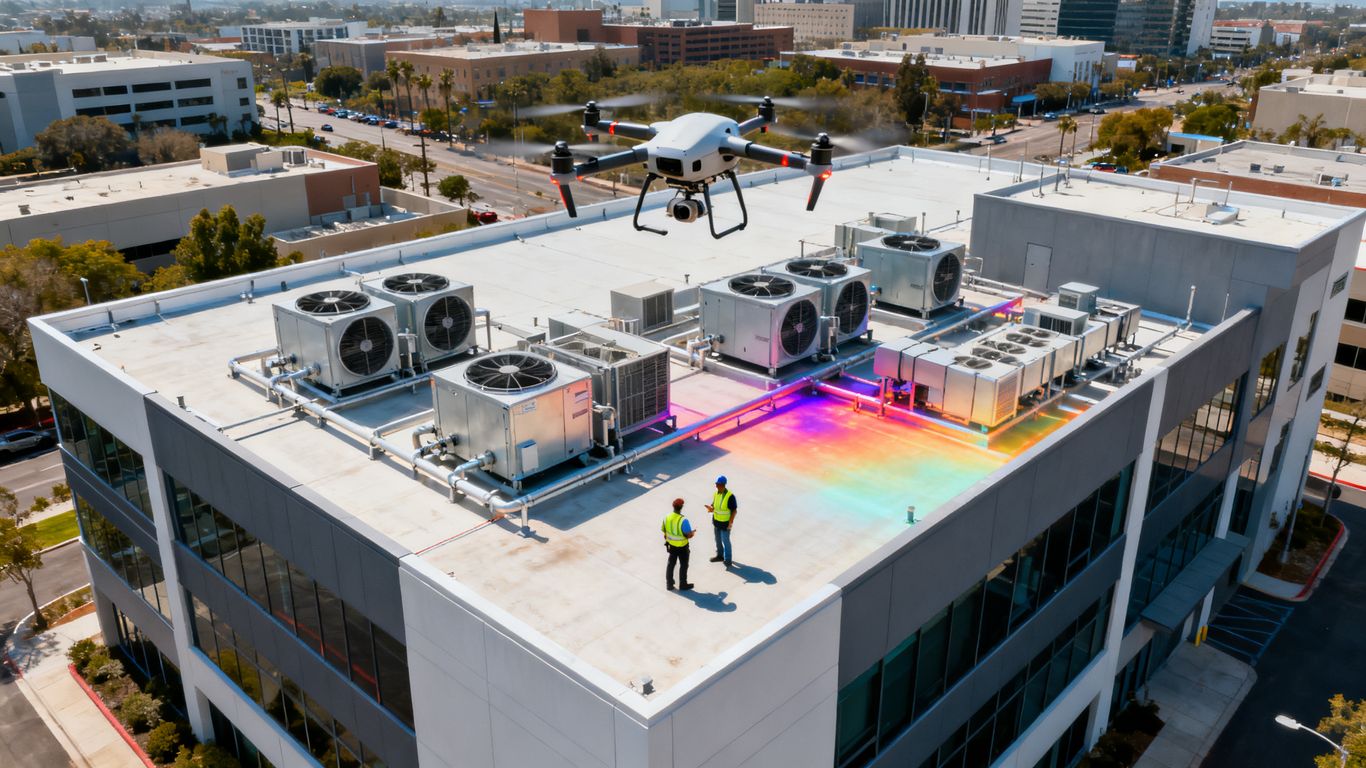
A commercial HVAC rooftop drone thermal inspection combines an overhead view with temperature information that ordinary photographs cannot provide. It can help a facility team see patterns across several units, identify areas that warrant closer attention, and plan limited follow-up work more deliberately. The result is most useful when it is treated as an early assessment rather than a final mechanical diagnosis.

The value is not simply that a drone flies above the building. It is that the resulting imagery can give managers and technicians a shared visual record of equipment condition, roof context, and apparent anomalies.
How thermal imaging identifies abnormal heat patterns
Thermal cameras record differences in surface temperature and display them as contrasting colors or tones. A warm electrical connection, an uneven condenser area, or a section of ductwork with a different heat signature may stand out against nearby surfaces. Those differences are clues that should be reviewed alongside operating conditions, weather, and the equipment’s design.
A single bright spot is not automatically a failure. Sun exposure, reflections, recently cycled equipment, wind, and load can all affect the image. Good interpretation looks for patterns, not dramatic colors.
Which rooftop HVAC components can be assessed
From a safe standoff position, a drone may document rooftop units, condenser sections, fans, service panels, nearby ductwork, curbs, and surrounding roof areas. Visual imagery helps establish physical condition and equipment context, while thermal imagery can point to unusual heat distribution. The exact usefulness depends on access, camera angle, unit operation, and atmospheric conditions.
This broader view also helps teams understand whether an apparent issue is isolated to one unit or occurs across a group of similar assets. Thermal Drone Inspections are most valuable when the captured information is organized around the decisions the facility team needs to make.
When aerial data provides more value than manual inspection
Aerial data is particularly useful when units are numerous, access is awkward, or a preliminary review can prevent unnecessary roof travel. It can also provide a consistent record for properties that need periodic comparison. A ground-based pilot and a well-planned flight can review rooftop context before a technician is sent to investigate a specific concern.
That does not make manual inspection obsolete. Instead, the drone view can help focus hands-on time where it is most justified, reducing broad exploratory walks and improving preparation for the visit.
What thermal inspections cannot diagnose on their own
Thermal imagery cannot, by itself, confirm a refrigerant charge, prove that a motor bearing is failing, measure airflow, or establish the root cause of every temperature difference. It also cannot replace electrical testing, pressure checks, manufacturer procedures, or the judgment of a qualified HVAC professional. A thermal anomaly should therefore be reported as an observation and a recommended follow-up, not as an unsupported diagnosis.
The strongest reports separate what the camera shows from what still needs to be tested. That distinction protects maintenance budgets and keeps a useful screening tool from being oversold.
How to prepare a commercial rooftop HVAC drone inspection
Preparation determines whether the flight produces actionable information or merely a large folder of images. Start with the equipment list, operating context, and decisions the inspection must support. A short planning call with the facility team can resolve many problems before the pilot arrives.
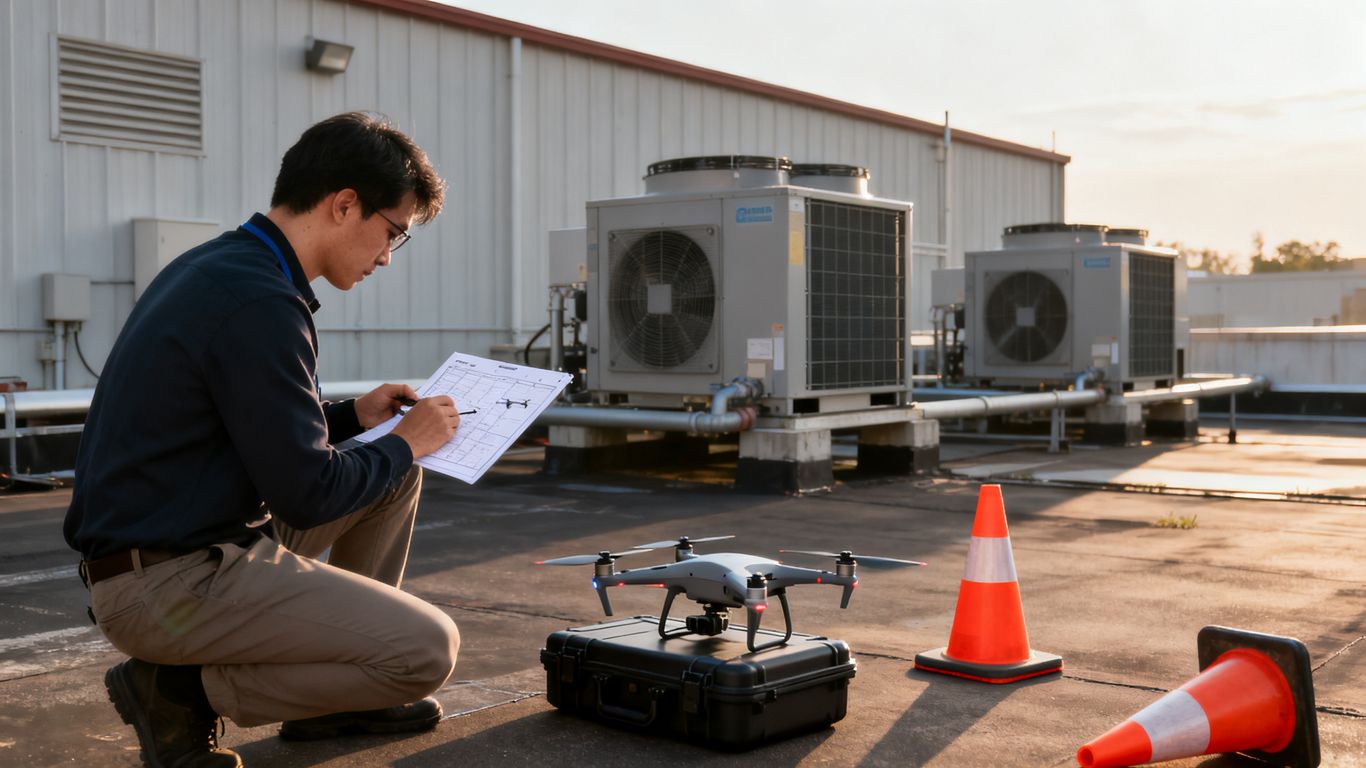
The inspection plan should account for people, roof access, weather, airspace, equipment status, and data delivery. Those details are practical controls, not administrative overhead.
Defining inspection goals and priority equipment
Begin by identifying whether the goal is routine condition review, investigation of a reported performance issue, documentation before maintenance, or comparison across units. Collect unit numbers, locations, approximate ages, recent complaints, and known repair history. If only a few units are causing concern, mark them clearly rather than treating every asset as equally urgent.
A defined objective also shapes the report. For example, a manager may need a ranked list of units for follow-up, while a contractor may need paired visual and thermal views with equipment identifiers.
Reviewing roof access, site conditions, and airspace restrictions
The team should confirm launch and recovery areas, nearby structures, roof edges, antennas, parapets, trees, cranes, and overhead lines. Check whether the property sits near an airport, heliport, controlled airspace, or another restricted area. Site access should also include a place for the pilot to maintain a safe operating position and a clear view of the aircraft.
Do not assume that a large open roof is automatically simple to fly. HVAC equipment can create narrow corridors, wind turbulence, and visual obstructions that affect the flight plan.
Coordinating with building occupants and facility teams
Facility staff can identify occupied roof areas, scheduled deliveries, security procedures, sensitive operations, and equipment that must remain running during capture. Occupants should understand when the flight will occur and who to contact if a concern arises. Maintenance personnel can also explain which units are operating normally, recently serviced, or intentionally offline.
That context makes the images easier to interpret and reduces the chance of mistaking a planned shutdown for an equipment fault.
Choosing the right drone, camera, and weather conditions
The aircraft and payload should match the site, required resolution, stand-off distance, and reporting goal. Thermal capture is generally more informative when equipment is operating under a meaningful load and when weather conditions are stable enough for comparison. Strong wind, rain, glare, rapidly changing sunlight, and wet surfaces can complicate interpretation.
A practical preflight checklist usually covers:
- Unit operating status and inspection priorities.
- Launch, recovery, and emergency landing locations.
- Airspace authorization and site-specific restrictions.
- Weather, lighting, wind, and thermal operating conditions.
After the checklist is complete, the pilot can adjust the mission rather than forcing a marginal flight. That small pause often improves both safety and data quality.
How the drone inspection process works
A professional flight is a controlled data-collection exercise, not a quick pass over the roof. The pilot plans how to see each unit, maintain safe separation, and record enough context for someone who was not on site to understand the finding. Visual and thermal capture should support one another throughout the mission.
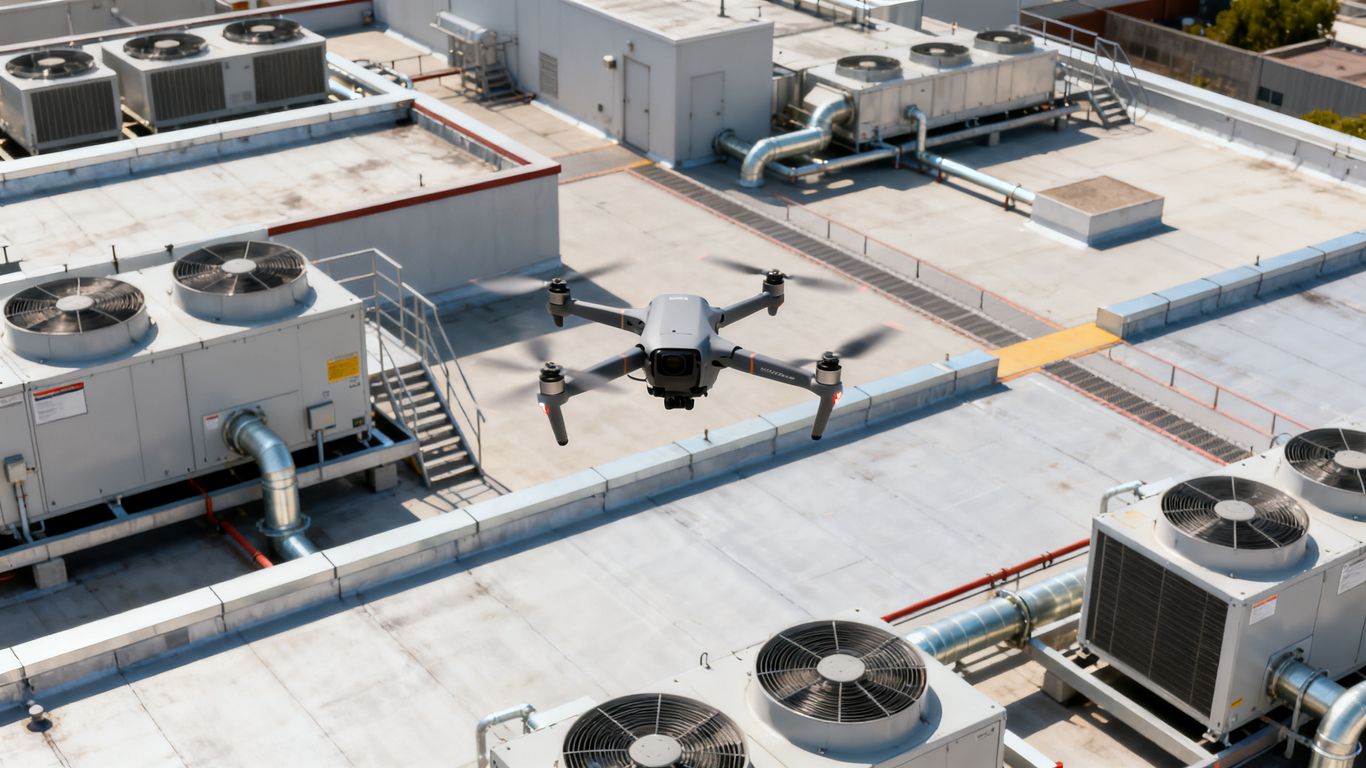
A consistent process also makes later inspections easier to compare. Even simple repeatability in camera angle, distance, naming, and equipment identification can improve the usefulness of the final record.
Planning flight paths around rooftop units and obstructions
The flight path should account for unit height, roof edges, vents, exhaust, cranes, parapets, and nearby structures. The pilot may use a perimeter pass for context followed by closer, deliberate views of priority equipment. Safe standoff distances and visual line of sight should remain central to the plan.
The path should also leave room for abnormal situations. A route that looks efficient on a map may be unsuitable once wind, glare, or an unexpected obstruction is visible from the pilot’s position.
Capturing thermal and visual imagery together
Thermal imagery shows temperature differences, while RGB imagery helps explain what is physically present at the same location. Capturing both views gives reviewers a way to connect an unusual heat pattern with a panel, fan area, coil, conduit, or roof feature. Each frame should be associated with the relevant unit whenever possible.
The purpose of pairing the images is clarity. A thermal image without context can be difficult to act on; a visual image without thermal information may miss a developing concern.
Maintaining consistent flight altitude and camera settings
Comparable imagery requires more than pointing the camera at the equipment. The pilot should keep distance, angle, focus, palette, and relevant thermal settings as consistent as site conditions allow. Any meaningful change in operating status, sun exposure, or weather should be recorded.
Consistency supports cautious comparison across units and across dates. It does not eliminate the need for interpretation, but it reduces avoidable differences created by the capture process itself.
Documenting equipment identifiers and site observations
Each unit should be tied to a clear identifier, location, and observation. Notes can include operating status, visible damage, unusual noise reported by staff, access limitations, and anything that may affect thermal interpretation. A well-labeled file is far more useful than an impressive image with no location or context.
For teams managing larger inspection programs, commercial drone inspections can fit into a broader aerial documentation workflow when the assignment calls for organized visual information around a complex site. The scope still needs to be defined specifically for the HVAC task.
How to interpret thermal anomalies in HVAC equipment
Interpretation begins with context. A thermal camera reports surface temperature patterns, but those patterns are shaped by load, ambient conditions, materials, airflow, sun, and equipment design. Reviewers should compare related areas and ask whether the difference is repeatable and operationally meaningful.
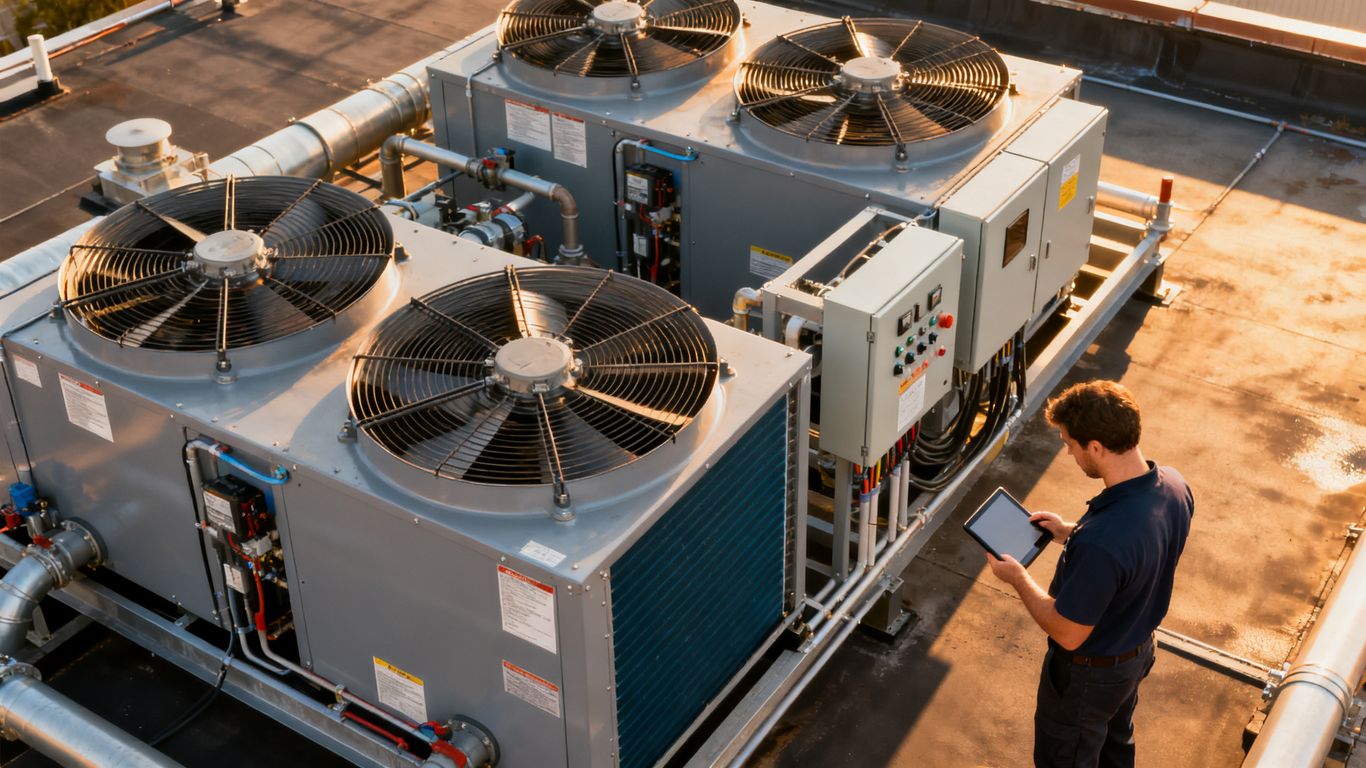
The report should avoid turning color differences into automatic diagnoses. A careful anomaly review identifies what is visible, explains why it may matter, and recommends the next verification step.
Distinguishing normal operating heat from potential faults
Normal operating heat is not necessarily uniform across a unit. Motors, compressors, electrical components, discharge areas, and sun-facing surfaces may naturally appear warmer. A potential fault becomes more credible when the pattern is unexpected for that component, differs from comparable units, or persists under similar operating conditions.
Reviewers should record the inspection time and equipment state. Without those details, even a genuine temperature difference may be impossible to interpret confidently later.
Spotting electrical issues, blocked airflow, and failing components
Thermal imagery can flag unusual heating around electrical connections, panels, motors, and other components. It may also show uneven patterns associated with airflow concerns or a section operating differently from the rest of the unit. These observations can help technicians decide where to begin, but they do not identify every underlying cause.
The practical next step is targeted verification. A technician may need to inspect connections, filters, coils, belts, bearings, controls, or airflow with appropriate instruments and procedures.
Comparing temperature differences across similar rooftop units
Relative comparison is often more informative than a single absolute reading. Similar units on the same roof can provide a useful reference when they operate under comparable load and environmental conditions. The comparison should still account for age, orientation, set points, recent service, and differences in design.
A simple comparison table can help a manager see why one unit deserves earlier attention than another. It should support judgment, not pretend to replace it.
| Comparison point | What to record | Why it matters |
|---|---|---|
| Unit identifier | Location and asset number | Connects imagery to the correct equipment |
| Operating state | Running, idle, or recently serviced | Explains some temperature variation |
| Thermal pattern | Area, direction, and relative difference | Describes the observed anomaly |
| Follow-up need | Inspection, testing, or monitoring | Turns observation into an action |
Once the rows are reviewed with the facility team, the inspection becomes easier to use in a maintenance meeting. The value lies in connecting the image to a decision and an owner.
Validating findings with maintenance records and follow-up tests
Compare the imagery with work orders, recurring complaints, service dates, and known equipment history. A unit with a repeated fault and a corresponding thermal pattern may deserve prompt testing, while a new anomaly on an otherwise stable unit may call for confirmation before escalation. Follow-up results should be added to the record.
This feedback improves future inspections. It also keeps the thermal report grounded in evidence rather than allowing an isolated image to drive an unnecessary repair.
Safety and compliance considerations for rooftop drone inspections
A drone can reduce the need for people to walk across a roof, but it does not remove operational risk. The pilot must manage the aircraft, the surrounding site, people below, active equipment, and changing conditions. Safety planning should be specific to the building and mission rather than copied from a generic template.
The same applies to compliance. Authorization, pilot qualifications, local restrictions, insurance, privacy, and site rules should be confirmed before flight. Documentation of those checks gives the facility owner a clearer record of responsible operations.
Managing people, structures, and active equipment below the flight area
Establish a controlled operating area and coordinate with building staff before launching. Keep people clear of the flight path, account for roof edges and fragile surfaces, and avoid creating distractions around active mechanical equipment. The pilot should know where the aircraft can safely go if the mission must be paused.
A ground observer or site contact may help with awareness, but responsibility for a safe operation still requires clear roles and communication.
Following FAA requirements and local operating restrictions
The operator should determine which FAA rules, authorizations, airspace limitations, and operating conditions apply to the mission. Local property rules, municipal restrictions, and client requirements may add another layer. These checks should occur before scheduling the flight, not after the aircraft is at the site.
When a mission cannot be conducted lawfully or safely as planned, rescheduling or changing the scope is the professional choice. A faster inspection is not useful if it creates a compliance problem.
Protecting sensitive building and infrastructure data
Thermal and visual imagery may reveal equipment layouts, roof access points, security features, or other sensitive information. Agree in advance on who can access the files, how they will be transferred, how long they will be retained, and whether contractors may receive copies. File naming and permissions should support accountability.
A clear data-handling process protects the owner and makes the deliverables easier to manage after the immediate maintenance question has been answered.
Handling inspections near airports, power lines, and restricted sites
Sites near airports, heliports, power lines, government facilities, or other restricted areas require additional planning. The pilot should verify the applicable restrictions and identify hazards that may not be obvious from a satellite view. If the required operating conditions cannot be met, the inspection should not proceed until an acceptable plan is in place.
This is one reason provider selection should include compliance experience, not just camera specifications. The safest mission is one that is properly scoped before arrival.
Turning drone inspection data into maintenance decisions
The inspection is only useful when the information reaches the people who can act on it. A report should make it easy to connect each observation to an asset, a level of concern, a recommended next step, and a responsible team. Raw files alone often leave the manager doing the organizing later.
For construction and engineering teams, organized aerial data can be especially helpful when several stakeholders need the same visual record. The deliverable should be tailored to the decision, whether that means a short priority summary or a fuller asset-by-asset package.
Prioritizing urgent repairs by severity and operational risk
Not every anomaly deserves the same response. Rank findings by apparent severity, likelihood of affecting operations, safety implications, consequence of failure, and confidence in the observation. A unit serving a critical occupied area may warrant faster follow-up than a similar anomaly on a redundant system.
A useful priority label should be understandable to both a facility manager and a contractor. It should guide scheduling without claiming more certainty than the evidence supports.
Creating annotated thermal reports for contractors and managers
Each report should include paired visual and thermal images, a unit identifier, location, capture conditions, a concise observation, and a recommended verification step. Annotations should point to the relevant area without obscuring the original image. Managers often need a summary page, while technicians may need the detailed frame set.
The report becomes much more useful when it answers three basic questions: what was observed, where was it observed, and what should happen next?
Integrating findings with preventive maintenance programs
Thermal observations can inform inspection frequency, work-order planning, and seasonal checks. They should be entered into the same maintenance process used for other evidence, with the original files retained according to the owner’s policy. Over time, recurring patterns may help the team adjust its preventive priorities.
The workflow should remain modest and practical. A carefully labeled finding that reaches the right technician is better than an elaborate system no one maintains.
Using repeat inspections to track equipment performance over time
Repeat flights can show whether a pattern has changed after cleaning, repair, load adjustment, or component replacement. Comparisons are most meaningful when the capture conditions and operating states are reasonably similar. Differences should be documented rather than hidden.
A trend record can help a manager decide whether to monitor, test, repair, or replace. It can also provide useful context when a unit’s performance changes between scheduled service visits.
How to select a commercial HVAC drone inspection provider
The right provider should be evaluated as an inspection partner, not only as an aircraft operator. Ask how the team plans the mission, manages compliance, captures thermal and visual data, labels equipment, and explains uncertainty. A polished flight with weak documentation may be less useful than a simpler mission built around clear maintenance decisions.
The provider should also be willing to define what the inspection can and cannot answer. That candor is a sign that the resulting information will be handled responsibly.
Evaluating pilot qualifications and thermal imaging expertise
Confirm the pilot’s authorization and experience with commercial sites, constrained airspace, rooftop hazards, and thermal capture. Ask who interprets the images and whether that person understands the limits of surface-temperature data. The team should be able to explain how weather, load, angle, and equipment condition affect the findings.
A provider familiar with professional drone guides may offer useful planning context, but the actual assignment still needs a site-specific method and qualified personnel.
Comparing deliverables, turnaround times, and reporting standards
Compare more than the number of photographs. Ask whether the deliverable includes paired imagery, equipment identifiers, annotations, capture conditions, a priority summary, and recommendations for follow-up. Confirm expected turnaround and how urgent findings will be communicated.
A short sample report can reveal whether the provider writes for working managers and technicians or simply exports camera files. The format should fit the client’s maintenance process.
Asking about insurance, data ownership, and quality controls
Clarify insurance coverage, authorization responsibilities, data ownership, retention, file security, and revision procedures. Ask how the team checks image quality and handles incomplete coverage or a flight interrupted by weather. These questions protect both the property owner and the inspection provider.
Written answers are preferable to assumptions. They make the scope easier to approve and reduce disputes after the work is complete.
Measuring ROI through reduced downtime and targeted repairs
Return on investment should be measured against the decision the inspection supports. Relevant indicators may include avoided roof exposure, fewer unnecessary site visits, earlier identification of maintenance concerns, better contractor preparation, and less disruption to occupants. The right benchmark differs by building and equipment criticality.
The goal is not to promise that every inspection will prevent a failure. It is to create reliable information that helps the team spend maintenance time where it has the greatest practical value.
Get a Site Assessment
If your facility team needs a safer, more organized starting point for rooftop equipment review, contact Aeroskape to discuss the site, inspection goals, access conditions, and the data your maintenance team needs.
Conclusion
A commercial HVAC rooftop drone thermal inspection is most effective when it combines safe flight planning, paired visual and thermal imagery, careful interpretation, and clear maintenance follow-through. Used within those limits, it can help teams screen difficult rooftops, focus hands-on work, and build a more useful record of equipment condition.
Frequently Asked Questions
What is a commercial HVAC rooftop drone thermal inspection?
It is an aerial inspection that combines thermal imagery with ordinary visual photography to review rooftop HVAC equipment and surrounding conditions. The findings are used to identify areas that may need closer testing or maintenance attention.
Can thermal imaging confirm that an HVAC component has failed?
No. Thermal imaging can reveal unusual surface-temperature patterns, but confirmation usually requires hands-on inspection, electrical testing, airflow checks, manufacturer procedures, or other diagnostic work.
Which HVAC equipment can a drone inspect?
A drone may capture imagery of rooftop units, condenser sections, fans, panels, ductwork, curbs, and nearby roof areas. The usable scope depends on operating conditions, camera quality, access, weather, and safe flight distance.
Does a drone inspection eliminate the need for technicians to access the roof?
Not always. It can reduce unnecessary exploratory access and help target follow-up work, but technicians may still need to visit the roof for testing, repair, cleaning, or confirmation.
What weather is best for thermal rooftop inspection?
Stable conditions with suitable equipment operation are generally preferable. Rain, strong wind, glare, rapidly changing sunlight, and wet surfaces can make thermal patterns harder to interpret.
How should thermal anomalies be reported?
Reports should identify the unit and location, pair thermal and visual views, describe the observed pattern, record relevant conditions, and recommend a reasonable next verification step without overstating the diagnosis.
How often should commercial rooftop HVAC units be inspected by drone?
There is no universal interval. Frequency depends on equipment age, criticality, operating history, site access, seasonal conditions, maintenance needs, and whether repeat comparisons would support a specific decision.